

Fragmented Lover: A Discourse
Roland Barthes, ready to be seduced?

Strap in, you literary wildlings, because today we’re plunging into the electrifying chaos that is Roland Barthes. Yes, THE Roland Barthes, the intellectual heartthrob of semiotics and the lyrical magician who gave us (among many, many other things) A Lover’s Discourse: Fragments.
Imagine Paris, a moonlit walk along the Seine, crossing near Notre Dame, and stumbling upon Shakespeare & Company. The scent of old books, the whisper of literary ghosts, and there you are, clutching Barthes, your heart racing. This is not just a book—it’s a fever dream, a lover’s lament, and an intellectual orgy all wrapped into one. And the effervescent, sparkling beauty that is Sylvia Whitman slaps her rubber stamp onto your chest and the ink drips down off your fingertips. You’re sodden in smudged fingerprints. Your whole life flashes before you. She places you inside a small, brown paper back and sends you off back into the night. Ready to be seduced?
I know that last part seemed like merely a sensuous flight of fancy, but it’s actually a true story. I walked down the river to the bookshop, I found the book, not really knowing what is was (a Barthes virgin at this point), had a flick through, fell head over heels, marched to the counter, Sylvia stamped the famous logo into the front page, I was oddly starstruck and was unable to produce sounds in any order that could be spliced together to make words in post-production, she handed me my book(s) in a brown, paper bag, and I fell off the doorstep into the night. I got back to my hotel before I realised what had happened, and starfished on my hotel bed brandishing the book. I read most of it in one sitting. Since then I’ve been working very, very hard to put back together all of these fragments I didn’t even know I had. (And that sentence alone just summoned a whole mood of poets, yes, I’m pretty sure that’s the collective noun!)
A Lover’s Discourse: Fragments
This isn’t your run-of-the-mill love story. A Lover’s Discourse is a cross-section of desire, obsession, and heartache. Barthes doesn’t just write about love—he dissects it, flays it open, and invites you to secrete yourself between the layers, and revel in its messy beauty. Imagine every kiss, every stolen glance, every heartbreak laid bare with surgical precision and a final poetic flourish. It’s basically a poet’s thesaurus.
Here’s Barthes in all his glory:
"I am languishing, I am burning, I am bursting. What more could I want? I want what I have already; I am pitiful."
Barthes' A Lover's Discourse is a profound exploration of how we talk about love, capturing the complexities and paradoxes that define romantic relationships. The text is structured in fragments, each focusing on a different aspect of love, such as waiting, jealousy, and desire. Barthes masterfully uses his knowledge of semiotics to decode the signs and symbols embedded in the language of lovers, making the invisible visible and the ineffable spoken.
Barthes’ work is not just a dry academic treatise; it's a rich, poetic meditation on love. His ability to weave literary references with personal anecdotes creates a tapestry that is both intellectually stimulating and deeply moving. It’s very much in the world of the semiotextual (if you don’t own any semiotexte books, you’ll also want to correct that pretty swiftly too. And check out some Wayne Koestenbaum too. I have written some recommendations on his books already!)
"Language is a skin: I rub my language against the other. It is as if I had words instead of fingers, or fingers at the tip of my words"
This book is an emotional supernova, a chaotic symphony of the heart. Each fragment is a moment frozen in time, a raw individual nerve of splintered emotion that demands your full attention. You read it, and suddenly, you’re no longer alone in your wild, feverish love. Barthes is there, whispering in your ear, guiding you through the labyrinth of your desires. He says “vivisection can be tender”, slaps your cheek and shushes you.
"To try to write love is to confront the muck of language: that region of hysteria where language is both too much and too little, excessive and impoverished."
Right, there’s a PDF online of the entire book. Take 10 minutes to read the first 9 pages. If it doesn’t grab you by the brain strings in that time, you’re beyond saving, I’m sorry. I can’t help you. And if you refuse to read the first 9 pages, I refuse to help you! Here she is: A Lover's Discourse PDF
Mythologies
Mythologies is Barthes’ playground, where he tears apart the fabric of everyday life to reveal the cultural myths that shape our reality. It’s a myth making factory! From wrestling matches to the visage of Greta Garbo, Barthes exposes the symbols that govern our lives. This isn’t just reading—it’s a revelation, a peeling back of the world’s superficial layers to reveal the raw, pulsating truth beneath.
"Myth is neither a lie nor a confession: it is an inflection."
Launch into Mythologies, and you’ll never look at the mundane the same way again. Every symbol, every sign becomes a treasure trove of poetic potential. I could surely wax lyrical about the multitudinous perks of reading Barthes as a poet, and I’m sure I will, but for now this is more of a primer.
So, where the last one was a poet’s thesaurus, this one is more of a “Oh, Do you notice things? Well, let me tell you a few things to freshen that up a smidge! It’s crazy out there…” kinda book. I suppose for neurodivergent folk it’s just pattern recognition but on a supreme higher level.
Camera Lucida: Reflections on Photography
If you’ve ever been haunted by a photograph, Camera Lucida will speak to your soul. Barthes’ exploration of photography, memory, and loss is both poignant and profound. His reflections on a photograph of his mother will pierce your heart, leave you contemplating the nature of existence and why it plucked us out of the ether in the first place, we didn't ask for this, any of it.
"What the Photograph reproduces to infinity has occurred only once: the Photograph mechanically repeats what could never be repeated existentially."
This book is a meditation on the ephemeral and the eternal, perfect for those dark, introspective nights when you’re searching for meaning in the shadows.
Okay, we’ve had noticing, we’ve had finding the right words, and now we’ve got reading (too much) into stuff. You getting this poets?
S/Z
For the structuralists and deconstructionists among you, S/Z is Barthes at his analytical best. This meticulous breakdown of Balzac’s “Sarrasine” is a masterclass in narrative deconstruction. Barthes takes the text apart, revealing its hidden mechanics and offering a blueprint for understanding literature’s deeper structures. It’s like a director’s commentary of a book.
"To read is to find meanings, and to find meanings is to name them; but these named meanings are swept toward other names; names call to names, meanings to meanings."
S/Z will make you see literature in a new light, each word a universe of possibilities.
So far: Noticing, reading, writing. Now we’ve got deconstructing, playing with form and structure. Do you still need convincing to buy these?
N.B. There is a Roland Barthes Reader out there that you can buy, but I’m recommending you skip straight to A Lover’s Discourse. And where you go from there depends how best you think you can fix your broken heart from there. Sorry not sorry.
Barthes/z: The Man, The Mythologies, The Lucid Lover
Roland Barthes, born in 1915, was a literary critic, philosopher, and semiotician whose work revolutionised modern literary theory. Chuck a rock at an arts student’s book shelf and you’ll hit Barthes, or John Berger, or Susan Sontag. Well, you should. I’ve only ever acquired any of these by my own volition. (I always recommend it to my students though!) His explorations of signs, symbols, and the layers of meaning in texts have left an indelible mark on contemporary thought. His legacy is particularly significant to queer audiences, offering a framework to explore and articulate the complexities of queer love and identity. Pair him with Foucault for added power, flair, and philosophical pizazz! Throw in some Sontag for a complete cultural re-reading mindgasm.
Barthes was also a closeted gay man whose sexuality profoundly influenced his work. His nuanced exploration of desire and identity resonates deeply with the LGBTQ+ community to this day. Barthes also had a penchant for puns and wordplay, often embedding layers of meaning in his texts that only the keenest of readers would catch.
Poets! The man loved wordplay. Bisexuals! The man loved puns.
This Week’s Chaotic Inspo Recommendation:
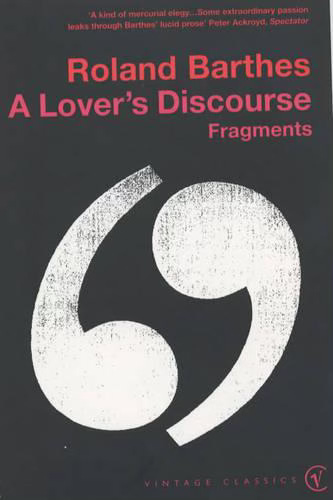
A Lover’s Discourse is not just a book; it’s an obsession, a whirlwind of emotions that will leave you genuinely breathless. (Annoyingly, this book actually breaks your heart and makes very little attempt to repair it. Pssst! By the way, the heart is in all these tiny fragments, oh, and also, you can never put it back together again, bye! Yeah, cheers for that Barthes, you beautiful bastard!) And if you’re ready to plunge deeper into Barthes’ chaotic genius, don’t stop there—immerse yourself in Mythologies, Camera Lucida, and S/Z. Each work is a gateway to new dimensions of thought and creativity. Like I said, reading, writing, noticing, deconstructing. What else is there? The truth? Nah.
Poets, lovers, and chaos enthusiasts, grab A Lover’s Discourse and let Roland Barthes seduce you into a world of intellectual and emotional ecstasy. Start your journey today and let his words transform your poetry writing, reading, and just life all-round really. You’ll surely look up from your book after a few hours and wonder if someone slipped something into your coffee!
Speeeeeeeeeeeeeaking of coffee! This is your first and final call of the post to click the coffee-dispensing button below. It’s June and the UK weather is behaving most peculiarly, so I’ve set the button to randomise the drink selection. I’m keeping things exciting by not knowing if I’m getting a hot coffee or an iced coffee. It’s the little things. Like an extra shot of espresso or a caramel syrup. Right, that’s enough from me. You’ll find me in the kitchen edging the kettle.