

VERSE TRAPS #3: DOUBLE EXPOSURE
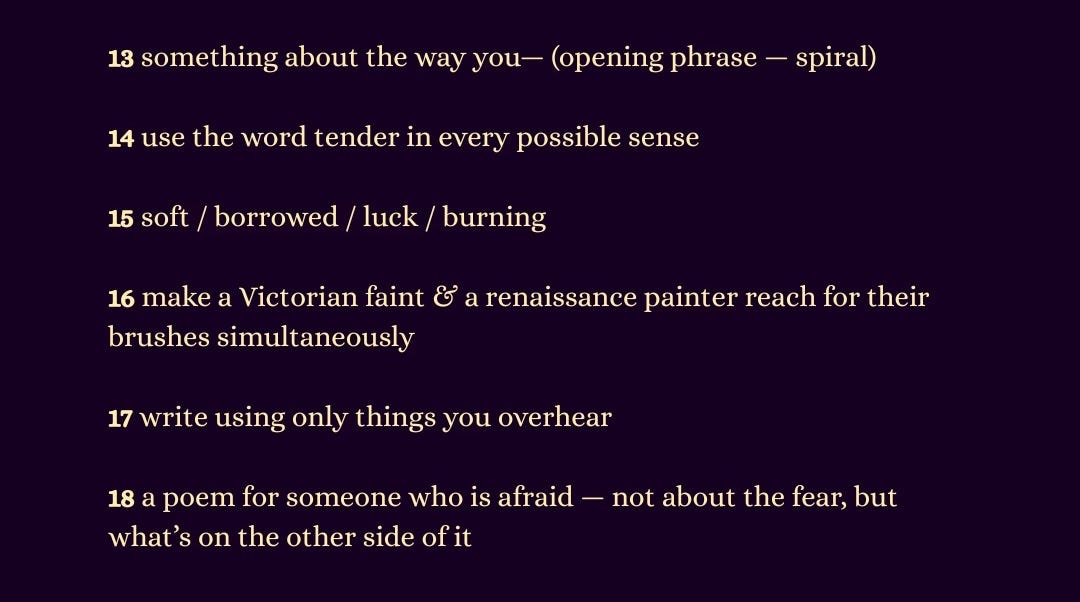
flux points: unclenchings

Week three —and the language is a skin,
tongues frisking shadows of teeth,
escaping with comical satires of their lurid adventures.
DOUBLE EXPOSURE.
Two images on the same frame, neither cancelling the other, the meaning alive in the overlap — the photograph that is also two photographs, the poem that arrives differently in every body that reads it, the surface that rewards a second look and a third and keeps giving. This week, we are writing the poem that knows it is doing two things simultaneously and does not apologise, explain, or resolve the friction between.
“My scars are different. If you look closely you’ll see that they’re not scars at all but tiny, sealed lips.” — Joelle Taylor
The body that is secretly a mouth. The wound that is also a testimony. The double exposure implicitly written into swathes of bruising skin before the poem begins.
Roland Barthes gave us two words for the way a photograph works on us — studium, the information the image gives willingly, the polite content of it, what it is “about”; and punctum, the detail that pierces without permission, the thing that pricks, that arrives unbidden and stays in the body long after the image is gone. The studium is what the poem says. The punctum is what the poem does to you, whether it meant to or not. The double exposure lives in the purpling gap between lenses.
“It reminds me that landscape is created; it’s what we put there. It’s the way we tell stories about the space; it’s the way we place our stories within space and say there, there is our landscape.” —- Jason Allen-Paisant
Poetry has always told it slantwise — Dickinson’s instruction was literal, the whole tradition has been finding oblique routes to the unsayable — but what I mean by double exposure here is something more deliberate, more desirant, more specific to the moment we’re in and the community we’re writing from and for. Not just the slant but the simultaneous. Not the metaphor standing in for the thing but the metaphor that is the thing, both true at the same time, both the poem. A coded love lyric that survives in the nuance of plain sight. The queer text that infiltrates the official or the poem that arrives differently in the body of the reader who knows and the body of the reader who doesn’t — and both receptions are correct, and neither is ever the whole truth; the poem lives in the fertile, unstable gap between them, & generates space & time immeasurably.
Jay Bernard builds a new poetic archive from the New Cross fire, writing through the official record to what it couldn’t contain — a stranger’s hand on my shoulder became a loving mouth / pressing its heat into mine, urgent tongue searching for a place / to pass the root in that way, to go knuckle deep in another — the double exposure as the queer archive’s method, the suppressed body surviving from within the official text. This is the palimpsextual reading in action: both layers present, neither erased, the earlier writing pinking through.
Commas hold your coat for you. — Gertrude Stein
This week we practise it. The Unclenchings are four ways of arriving at the poem from the direction of the second image. Unclenchings because the double exposure requires the hand to open, to release the grip on the single meaning, to let the two truths exist in the same breath without resolving either of them, and eventually, you have to learn to let go. When we write, we control the studium, but nobody can ever design, hold, control, influence, or change the punctum. No amount of pinking can shape the narrow aperture an audience is peering through when they read our writing, your gift is that you get your own pinkture too! And the combination of every layer of infinite shades of pink material is the palimpsexture you’re responsible for but, crucially, do not own.
Try to keep them, poet, those erotic visions of yours, however few of them there are that can be stilled. Put them, half-hidden, in your lines. — C.P. Cavafy, Hidden Things
Another four Flux Points?! Apply to any prompt. Combine willy-nilly. The poem is already doing two things. The Flux Point is the moment of translation — how the art of noticing is weaponised differently by each individual writer-as-reader, how the same image pierces differently in different bodies, how the poem is engineered to say and not say, a deliberate blurring of images, tongues blending into the backdrop of hands and other latecomers.
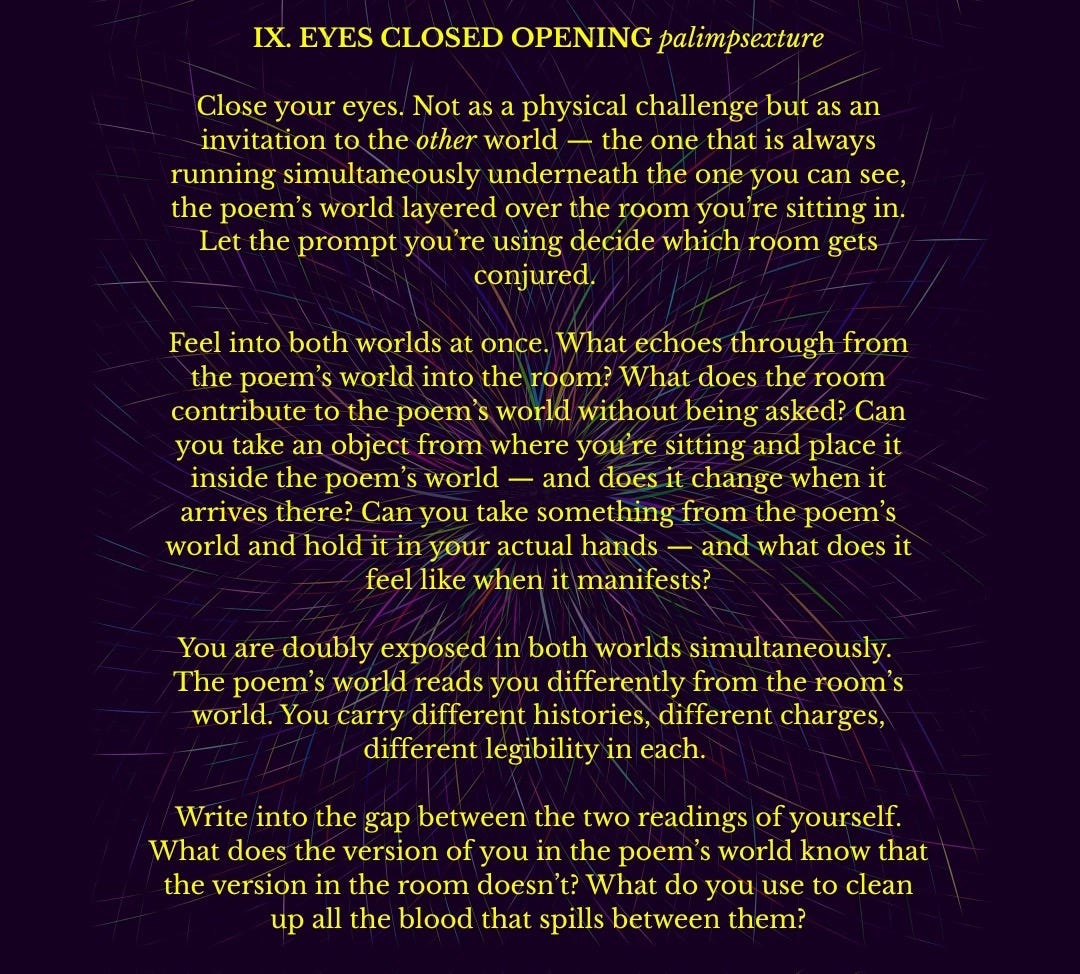
In the increasingly convincing darkness the words become palpable, like a fruit that is too beautiful to eat. — John Ashbery
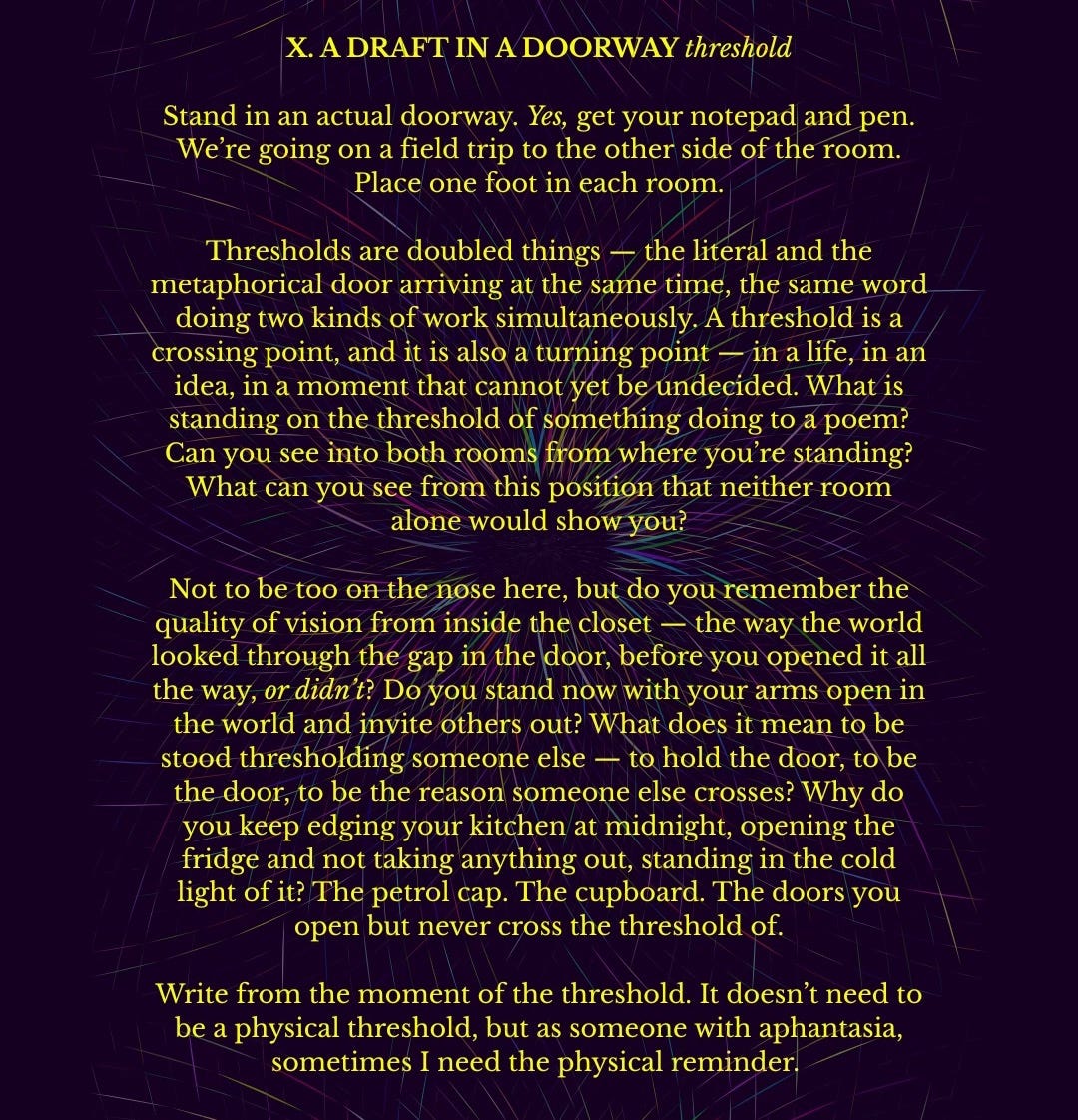
After all everybody who writes is interested in living inside themselves in order to tell what is inside themselves. That is why writers have to have two countries, the one where they belong and the one in which they live really. The second one is romantic, it is separate from themselves, it is not real but it is really there.
— Gertrude Stein
Odi et amo. Quare id faciam, fortasse requiris. Nescio, sed fieri sentio et excrucior.
I hate and I love. Why I do this, you perhaps ask. I don’t know, but I feel it happening and I am in agony. — Catullus, Poem 85
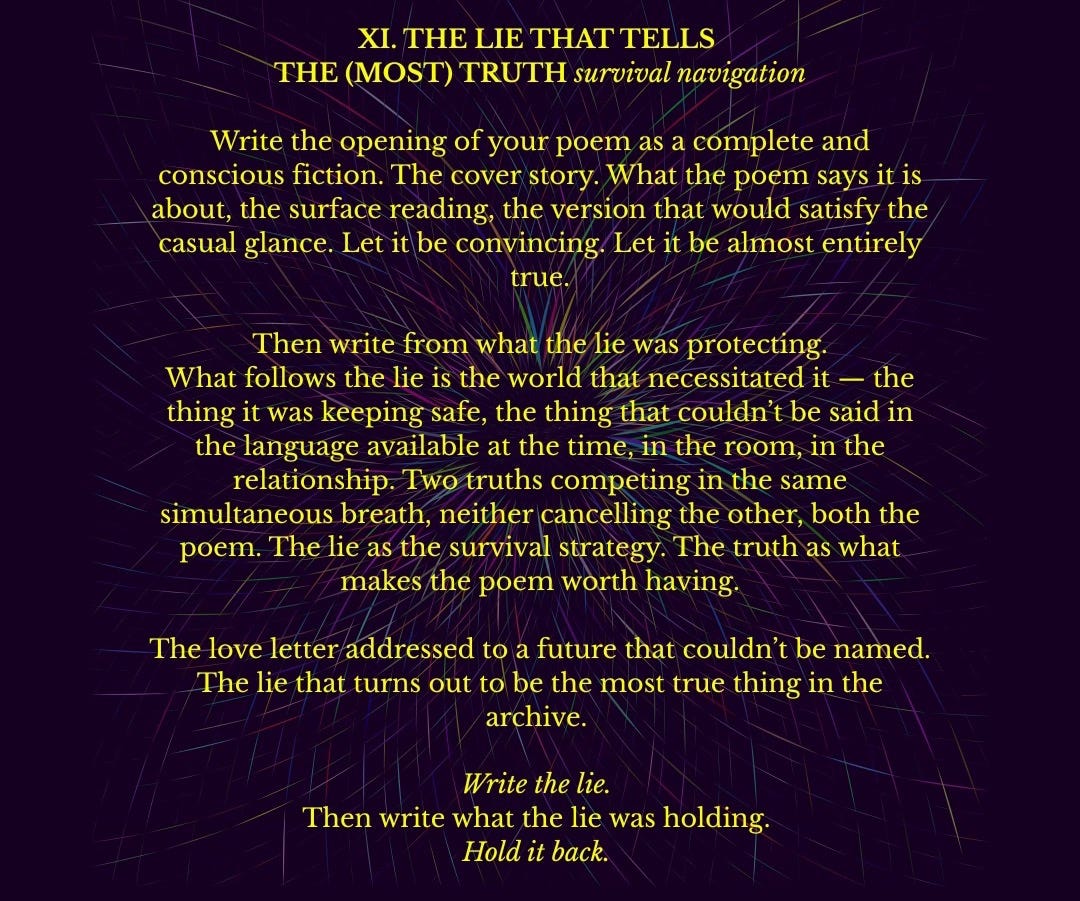
Seven words in Latin holding two thousand years of unresolved double exposure. The lie (I don’t know) protecting the truth (I feel it happening) while the truth is already in the lie. And Sappho, reaching across the same tradition in a different direction:
someone will remember us I say even in another time — Sappho, Fragment 147 (tr. Anne Carson)
The love letter addressed to a future that couldn’t be named. The lie that turns out to be the most true thing in the archive.
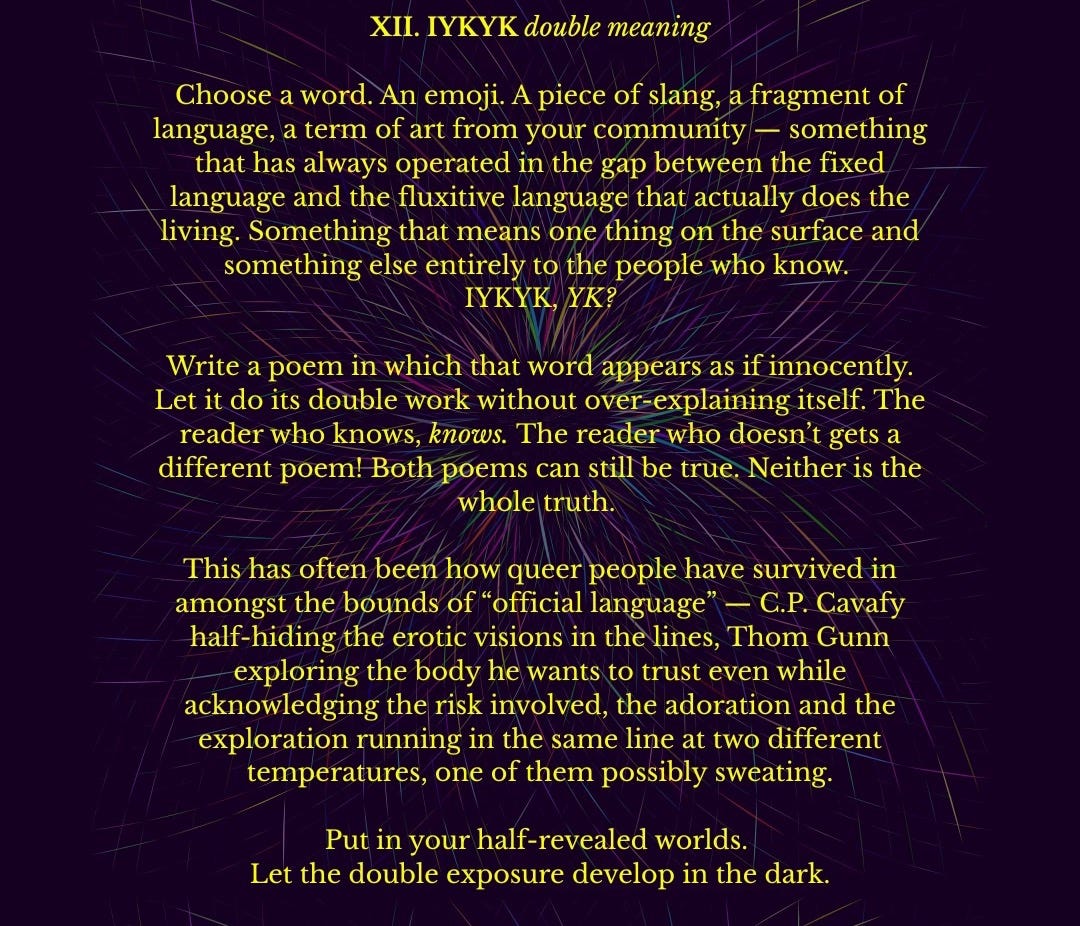
Grace / to be born and live as variously as possible. — Frank O’Hara, In Memory of My Feelings
VERSE TRAPPERS OF 2025
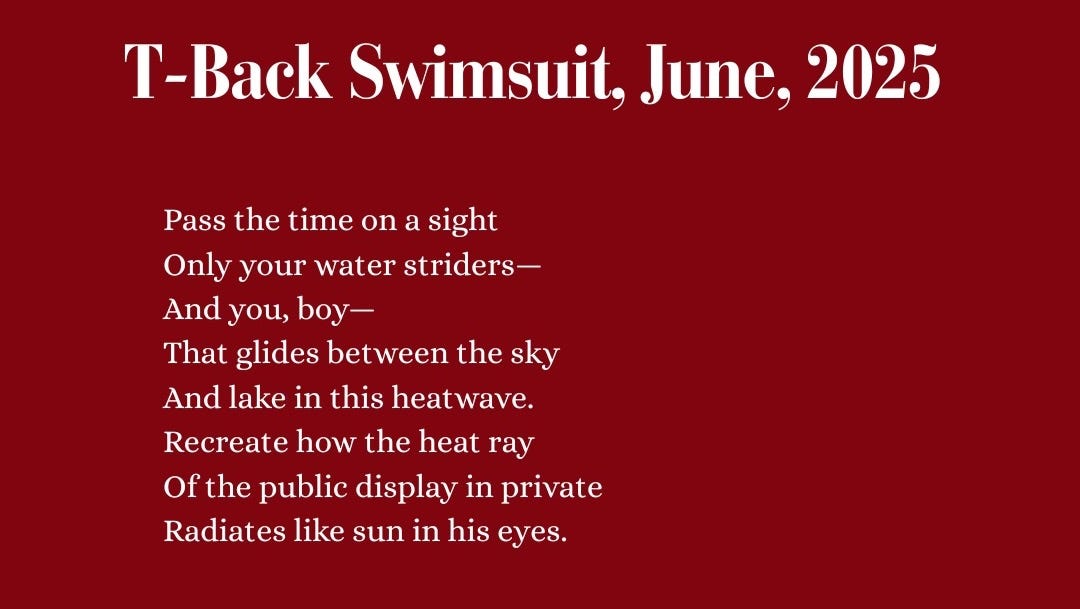
This week, experiencing Trapper’s Delight, is one of last year’s entrants, Lee Summers, from Old Improvidence, who won one of the Soft Snare prizes last year, with the poem “T-Back Swimsuit”.
As you know by now, I’ve contacted some Verse Trappers of yore to come back and share a few words, a poem, a chaotic photo, or something they’ve been working on since last year, and Lee is another one who has been working hard on a manuscript. I can’t really tell you much more than that, mostly because I don’t know anything! But I hear it’s been through beta readings and will be out in the world at some point soon. So, I guess you’ll have to go and subscribe to Lee directly to find out more, won’t you??
Lee shares plenty of poetry on their page, and it’s always a joy to read, so go check it out, and eagerly await a full collection like a good little Verse trapper would!
Here’s a little snippet Lee sent over to wet your proverbial whistle!
“I thought I’d just baptized myself of the sea. Silly of me to forget the little lagoons that never leave us at the cellular level. On the heels of drafting a rather marine collection manuscript, I’m diving deeper into research for an aquatic passion project I’ve left waiting in the seabed. Hopefully more will surface soon!”
To know blue beyond this tide,
what murmurs within this salt,
undulates, crashes on me.
— an excerpt from the upcoming manuscript
THIS WEEK — DOUBLE EXPOSURE
#VerseTraps2026 | tag @PoetChaotique | the archive is hungry
Next week: THE GOSPEL OF HOURS.
The night as queer time.
The collective body.
The hours that belong differently.
See you in the after-dark.
RST xo
QUEERLOGISMS
Pinkture (n.) — punctum + pinking + puncture = pinkture
the poem doing two things simultaneously, and the reader knowing, with a punch to the solar plexus, which thing is really conjured. The moment when you’re reading a poem and stop, look up into the middle distance, tilt your head, and just as your eyes widen, a thought launches itself up from the pit of your stomach and as it passes by, making its escape, catches from the tip of your tongue, the word “oh”.
Palimpsextual (adj.) — palimpsest + sexual + textual + texture = palimpsextual
the texture and sex haunt the word in the blur of the portmanteau — audible, plausibly deniable, hiding in plain sight, and also not hiding, and both simultaneously.
palimpsextuality is the condition of a text that carries multiple readings braided together — not stacked with a correct one on top, not layered so that one cancels another, but woven. Every reading is a layer of fabric in the same textile. What each reader brings determines which threads catch the light, which become visible, which recede — but none of them disappears. None of them was ever not there.
this layering is neither intentional nor incidental, but the nature of language under the myriad pressures of desire, suppression, the unspoken but not unsaid. multiple readings existing in unstable, mutually haunting relation.
Thank you for the shoutout! Now that I’m out from my day job for the summer, it’s time to make up for lost time with your prompts!
when you say pinking, do you mean the noise indicative of improper combustion in internal combustion engines? or pinking shears, or the wall plaster thing